
When we designed our Supplement Consumer PureSegmentation™ research (our proprietary, census-balanced segmentation study of adult supplement consumers), one of our goals was to uncover how supplement brands can communicate more effectively and deeply with their target segments.
A projective question is a research technique designed to reveal underlying attitudes by asking about something familiar and emotionally resonant.
We began with baseline questions about what consumers look for in supplement brands. The responses were necessary but often predictable: trusted, high quality, organic.
To go deeper, we turned to a projective question — a research technique designed to reveal underlying attitudes by asking about something familiar and emotionally resonant. Instead of asking directly about brands, we asked about consumers’ experiences with their healthcare practitioners. Practitioners often embody authority, empathy, and personalized attention. While consumers may not consciously connect those qualities to supplement brands, the metaphor works — because brands aspire to occupy a similar position of trust.
Specifically, we posed a deceptively simple projective question to more than 2,300 supplement users across the U.S.:
“Which of the following do you most appreciate about your experiences with your integrative or alternative healthcare professionals?”
By understanding what people value most in these relationships, we gain a roadmap for how brands can communicate more effectively — and more distinctively. Because when it comes to brand differentiation, it’s not just about the products. It’s about the experience, the trust signals, and the way people want to be treated.
What the Total Sample Tells Us
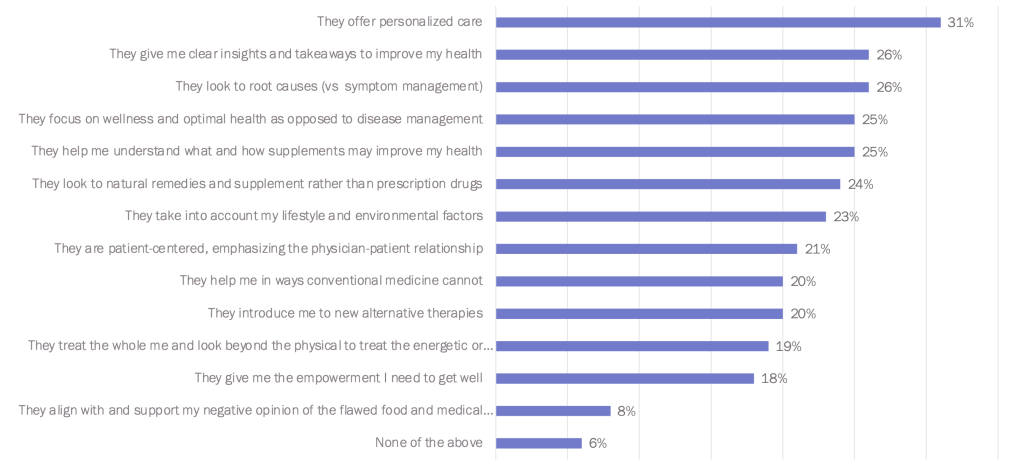
Across the total sample, the most appreciated quality was when practitioners offer personalized care.
For brands, this suggests that consumers want to be recognized as individuals. At first glance, many supplement companies will interpret this as personalization of supplements. But here’s where it gets interesting: the segments most interested in personalized supplement regimens are actually the ones who under-index for wanting personalized care from their healthcare professionals.
In the practitioner’s office, personalized care means empathy, listening, and tailoring advice. In supplements, personalization often means custom formulations, algorithms, or regimens built for “someone like me.” They overlap in perception, but they are not interchangeable — and brands risk confusion if they treat them as the same thing.
Why Totals Can Mislead
If you only look at the total sample, it seems every brand should lean entirely into “personalized care.” But segmentation reveals a more nuanced story:
- Some segments most appreciate practitioners who favor natural remedies and supplement regimens over drugs, and who connect recommendations to overall wellness and root causes.
- Others gravitate toward practitioners who help in ways conventional medicine cannot, signaling openness to discovery and new approaches.
- Another segment values clear insights and explanations — practical takeaways that make it easy to understand how supplements can improve their health.
- Still another emphasizes root causes, lifestyle and environmental factors, and will be drawn to brands that take a broader, systems-based view of wellness.
This is why totals can mislead. “Personalized care” is the universal headline, but beneath it lie different definitions of what truly builds trust. For some it’s natural solutions, for others it’s innovation, clarity, or lifestyle context.
From Practitioners to Brands
Consumers who find in your brand the same qualities they value in their practitioners will be more open to trusting you. But trust doesn’t come from trying to be everyone’s practitioner. It comes from knowing who you’re speaking to, understanding what they most appreciate, and delivering that consistently in your brand experience.
In today’s supplement market, where thousands of brands sell the same solutions at the same price, brand becomes the true differentiator. How you communicate with your target segment is essential to success.
Take echinacea — a product that is always in demand for the upcoming cold and flu season. Consumers have hundreds of legitimate options. Here are four distinct ways the same echinacea product could be positioned, each aligned to a different segment’s values:
- Natural orientation: “Our echinacea formula reflects a commitment to natural remedies, strengthening wellness without reliance on drugs. We focus on whole-body balance and root causes, supporting health the way nature intended.
- Innovation and discovery: “This echinacea blend goes beyond the conventional, drawing on herbal wisdom and innovative formulations to expand your options for wellness. For those seeking more than what mainstream medicine offers, it’s a trusted alternative.
- Clarity and insight: “With echinacea, clarity matters: we explain exactly how it supports your immune system and how to use it effectively. Our goal is to give you clear, practical insights that connect supplements directly to your health.
- Lifestyle and context: “Our echinacea is designed with your whole lifestyle in mind, recognizing that immune strength is shaped by environment, stress, and daily choices. By focusing on root causes, we help support resilience from the ground up.”
Each message sells the same product. Each is credible. But each appeals to a very different consumer mindset. The key is knowing which mindset your brand should speak to.
The Takeaway
What consumers value in practitioners is similar to what they value in supplement brands — but the meaning of that value shifts across audiences. Personalized care may be the universal headline, but brands must decide whether to express it through natural orientation, innovation, clarity, or lifestyle context.
That’s the opportunity: to stop competing on sameness, and instead craft your messaging so it feels like the brand is practicing the same kind of care your consumers already respect in their trusted practitioners.
This article is part of our ongoing PureSegmentation™ Insights series, where we share new findings and perspectives from our proprietary supplement consumer research.